MVP 개발 프로세스: 단계별 완벽 가이드
2월 10, 2026
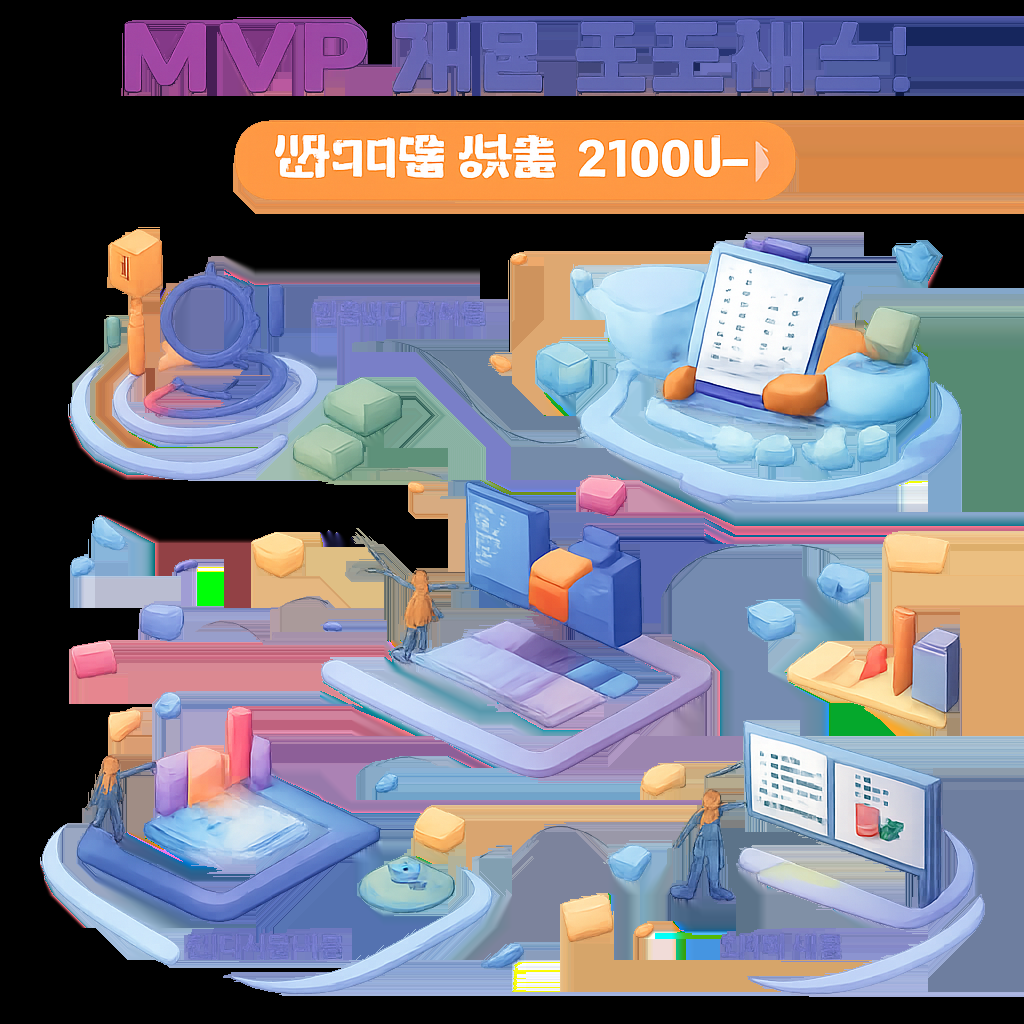
MVP 개발 전 준비: 성공적인 MVP 설계를 위한 필수 단계
Embarking on the MVP (Minimum Viable Product) development journey requires meticulous preparation, akin to charting a course before setting sail. This initial phase is pivotal, setting the stage for a successful MVP launch by validating ideas and deeply understanding the market.
Idea Validation and Market Analysis: The cornerstone of MVP development lies in rigorously validating your product idea. This involves more than just believing in your concept; it demands empirical evidence that your solution addresses a genuine market need. Techniques such as surveys, customer interviews, and focus groups are invaluable for gathering direct user feedback. Market analysis tools, like those offered by Statista or Forrester, provide data-driven insights into market size, trends, and potential.
Defining Core Features: Identifying the core features of your MVP is akin to distilling the essence of your product. Focus on the functionalities that directly address the primary problem your product solves. Avoid feature creep by prioritizing ruthlessly; every feature should be essential for early adopters. Techniques like the MoSCoW method (Must have, Should have, Could have, Wont have) can aid in prioritizing features.
Setting Goals and Success Metrics: Establishing clear, measurable goals is crucial for gauging the success of your MVP. Define what you want to achieve with your MVP – is it to validate a problem, test a solution, or acquire early users? Success metrics should be tied to these goals, using KPIs (Key Performance Indicators) such as user engagement, conversion rates, and customer acquisition cost. Tools like Google Analytics and Mixpanel can be instrumental in tracking these metrics.
Defining User Personas: Creating detailed user personas helps to humanize your target audience. These personas should represent your ideal users, including their demographics, behaviors, motivations, and pain points. Empathy mapping exercises can help to deeply understand your users needs and ensure your MVP resonates with them.
Competitive Analysis: Understanding your competitive landscape is vital for identifying opportunities and threats. Analyze your competitors strengths and weaknesses, pricing strategies, and target markets. Tools like SEMrush and Ahrefs can provide insights into competitors online strategies. Identify your unique selling proposition (USP) and ensure your MVP offers a distinct advantage.
With these foundational steps in place, the next critical phase involves selecting the right technology stack and development approach for your MVP.
MVP 개발 단계별 실행 전략: 효율적인 개발 프로세스 구축
Alright, lets dive deeper into crafting an effective MVP development process. From my experience in the field, Ive seen MVPs either skyrocket to success or crash and burn, and the difference often lies in how well the development process is structured and executed.
Prototyping: More Than Just a Mockup
First off, lets talk prototyping. Its not just about making something pretty to show stakeholders. A good prototype is a functional representation of your core value proposition. Think of it as a mini-MVP before the MVP. Tools like Figma or Adobe XD are great for initial designs, but dont shy away from low-code platforms like Bubble or Outsystems to add real functionality early on.
I recall a project where we were building a marketplace for local artisans. Initially, we spent weeks on high-fidelity mockups. But it wasnt until we built a functional prototype using Bubble—allowing users to actually list and purchase items—that we uncovered critical usability issues. For instance, the original design didnt account for the complexities of calculating shipping costs for different types of artisanal goods.
Tech Stack: Balancing Innovation and Pragmatism
Choosing the right tech stack is another critical decision point. Its tempting to go with the latest and greatest technologies, but resist the urge to over-engineer. Focus on whats necessary to deliver the core functionality of your MVP. A solid, reliable stack like React for the front end, Node.js with Express for the back end, and PostgreSQL for the database is often a safe bet.
I once consulted for a startup that insisted on using a cutting-edge NoSQL database for their MVP. While the technology was impressive, the team lacked experience with it, leading to performance bottlenecks and scalability issues. We ended up migrating to a more traditional relational database, which significantly improved performance and reduced development time.
Team Composition: Small, Agile, and Cross-Functional
When it comes to building your development team, think small, agile, and cross-functional. You need individuals who can wear multiple hats and collaborate effectively. A typical MVP team might include a product owner, a UX/UI design 포텐랩 외주 개발 er, a front-end developer, a back-end developer, and a QA tester.
In my experience, co-locating the team or at least ensuring constant communication through tools like Slack and Jira is essential. Daily stand-up meetings, sprint reviews, and retrospectives help keep everyone aligned and identify potential roadblocks early on.
CI/CD: Automating the Release Pipeline
Finally, lets talk about continuous integration and continuous deployment (CI/CD). Setting up a CI/CD pipeline from the outset is crucial for ensuring code quality and accelerating the release cycle. Tools like Jenkins, CircleCI, or GitLab CI can automate the process of building, testing, and deploying your code.
Ive seen firsthand how CI/CD can transform the development process. In one project, we implemented a CI/CD pipeline that automatically ran unit tests and integration tests whenever code was pushed to the repository. This allowed us to catch bugs early and often, reducing the time spent on debugging and improving the overall quality of the code.
Now, lets move on to discussing the specific challenges you might encounter during the actual development phase and how to tackle them head-on.
MVP 출시와 피드백 반영: 사용자 중심의 제품 개선
Alright, lets dive deeper into refining your product post-MVP launch, always keeping the user at the heart of our decisions.
Gathering User Feedback: The Gold Mine
Once your MVP is out there, its feedback time. Think of user feedback as gold – you need to mine it, refine it, and then use it to build something even better. Here’s how:
- Surveys: Short, targeted surveys can give you a broad sense of user sentiment. Use tools like SurveyMonkey or Google Forms. Keep it concise; no one likes a survey that takes longer than a few minutes.
- User Interviews: These are invaluable. Talking directly to users gives you nuanced insights that surveys can’t capture. Prepare open-ended questions and really listen to their experiences.
- Data Analytics: Tools like Google Analytics, Mixpanel, or Amplitude can track user behavior within your app. Where do users drop off? Which features are most popular? This data is crucial.
- Feedback Forms: Implement in-app feedback mechanisms. A simple Feedback button can work wonders.
- Social Media Monitoring: Keep an eye on social media. Users often share their experiences, both good and bad, on platforms like Twitter, Facebook, and Reddit.
Turning Feedback into Action: Prioritization
You’ll likely get a ton of feedback, so prioritization is key. Heres a structured approach:
- Categorize Feedback: Group feedback into themes. Are users struggling with a specific feature? Is there a common request for a new one?
- Severity Assessment: Evaluate the impact of each issue. Is it a minor annoyance or a showstopper that’s causing users to abandon your product?
- Effort Estimation: How much time and resources will it take to address each piece of feedback?
- Prioritization Matrix: Create a matrix that plots impact vs. effort. Focus on the high impact, low effort items first. These are the quick wins.
Iterative Development: The MVP Loop
MVP isn’t a one-and-done deal. It’s the start of a continuous loop:
- Build: Implement the prioritized changes and new features.
- Measure: Track the impact of these changes. Are users happier? Are they more engaged?
- Learn: Analyze the data and gather more feedback. What worked? What didn’t?
- Repeat: Go back to step one.
Real-World Examples: Learning from Others
Lets look at a couple of examples:
- Buffer: Buffer, a social media management tool, famously started with a landing page to gauge interest. They then launched a very basic MVP and iteratively added features based on user feedback.
- Dropbox: Dropbox started with a simple video explaining their concept. The overwhelming response validated their idea, and they then built their MVP.
Addressing Negative Feedback: A Case Study
Imagine you launch an MVP for a task management app. Users complain that the interface is confusing. Here’s how you might address it:
- Acknowledge the Issue: Respond to users and let them know you’re listening.
- Investigate: Use analytics to see where users are getting stuck. Conduct user interviews to understand their pain points.
- Design Solutions: Create wireframes or prototypes of a redesigned interface.
- Test: Conduct usability testing with users to get feedback on your proposed solutions.
- Implement: Roll out the changes.
- Monitor: Track user behavior to ensure the new interface is indeed more user-friendly.
The Next Step: Scaling Your MVP
Once you’ve validated your core value proposition and iterated based on user feedback, you’re ready to think about scaling your MVP. This involves expanding your user base, adding more features, and potentially exploring new markets. But that’s a whole other story for another time.
MVP 개발 성공과 실패 사례 분석: 교훈과 전략
MVP 개발 후 지속적인 성장 전략
MVP(Minimum Viable Product)를 성공적으로 런칭한 후, 많은 스타트업들이 직면하는 과제는 어떻게 지속적으로 성장할 것인가입니다. MVP는 시작일 뿐이며, 장기적인 성공을 위해서는 지속적인 개선과 확장이 필수적입니다.
데이터 기반 의사 결정
MVP를 통해 얻은 데이터를 분석하여 사용자의 행동 패턴, 선호도, 불만 사항 등을 파악해야 합니다. 예를 들어, 특정 기능의 사용률이 낮다면 그 원인을 분석하고 개선하거나, 사용자 인터페이스(UI)를 변경하여 사용성을 높일 수 있습니다. A/B 테스트를 통해 다양한 개선안을 시험하고, 가장 효과적인 방법을 선택하는 것이 중요합니다.
피드백 루프 구축
사용자 피드백은 제품 개선의 핵심입니다. 설문 조사, 사용자 인터뷰, 소셜 미디어 모니터링 등 다양한 채널을 통해 피드백을 수집하고 분석해야 합니다. 특히, 초기 사용자들의 의견은 제품의 방향성을 결정하는 데 중요한 역할을 합니다. 드롭박스의 경우, 초기 사용자들의 피드백을 적극적으로 반영하여 파일 공유 기능을 강화하고, 사용자 인터페이스를 개선했습니다.
지속적인 기능 추가 및 개선
MVP는 최소한의 기능만을 제공하므로, 사용자 피드백과 데이터 분석을 바탕으로 지속적으로 기능을 추가하고 개선해야 합니다. 새로운 기능을 추가할 때는 사용자 우선순위를 고려하고, MVP에서 검증된 아이디어를 바탕으로 확장해야 합니다. 에어비앤비는 초기에는 숙소 예약 기능만을 제공했지만, 사용자 피드백을 반영하여 여행 가이드, 액티비티 예약 등 다양한 기능을 추가했습니다.
MVP를 활용한 사업 확장 전략
MVP를 통해 제품의 시장성을 검증했다면, 사업 확장을 고려해야 합니다. 사업 확장 전략은 다음과 같습니다.
타겟 시장 확대
MVP를 통해 특정 타겟 시장에서 성공을 거두었다면, 다른 타겟 시장으로 확장할 수 있습니다. 예를 들어, 특정 지역에서 성공한 배달 서비스는 다른 지역으로 확장할 수 있습니다. 타겟 시장을 확대할 때는 각 시장의 특성을 고려하고, 현지화 전략을 수립해야 합니다.
제품 라인 확장
MVP를 통해 핵심 기능을 검증했다면, 관련 제품 라인을 확장할 수 있습니다. 예를 들어, 온라인 교육 플랫폼은 초기에는 특정 분야의 강의만을 제공했지만, 사용자 피드백을 반영하여 다양한 분야의 강의를 추가할 수 있습니다. 제품 라인을 확장할 때는 핵심 기능과의 연관성을 고려하고, 사용자 니즈를 충족할 수 있는 제품을 개발해야 합니다.
파트너십 구축
다른 기업과의 파트너십을 통해 사업을 확장할 수 있습니다. 예를 들어, 결제 서비스는 온라인 쇼핑몰과의 파트너십을 통해 사용자 기반을 확대할 수 있습니다. 파트너십을 구축할 때는 상호 이익을 고려하고, 시너지 효과를 창출할 수 있는 파트너를 선택해야 합니다.
MVP 개발 경험을 바탕으로 한 스타트업 성장 로드맵 제시
MVP 개발 경험은 스타트업의 성장 로드맵을 수립하는 데 중요한 역할을 합니다. MVP를 통해 얻은 교훈과 전략을 바탕으로, 장기적인 목표를 설정하고, 단계별 실행 계획을 수립해야 합니다.
핵심 역량 강화
MVP 개발 과정에서 얻은 기술적, 사업적 역량을 강화해야 합니다. 예를 들어, 개발팀은 새로운 기술을 학습하고, 마케팅팀은 사용자 분석 능력을 향상시켜야 합니다. 핵심 역량 강화는 스타트업의 경쟁력을 높이고, 지속적인 성장을 가능하게 합니다.
조직 문화 구축
스타트업의 조직 문화는 성장에 큰 영향을 미칩니다. 수평적인 의사소통, 자율적인 업무 환경, 성과 중심의 보상 체계 등을 구축하여 직원들의 만족도를 높이고, 창의적인 아이디어를 장려해야 합니다.
자금 확보
스타트업의 성장을 위해서는 지속적인 자금 확보가 필요합니다. 투자 유치, 정부 지원금, 은행 대출 등 다양한 자금 조달 방법을 고려해야 합니다. 자금을 확보할 때는 스타트업의 성장 단계와 재무 상황을 고려하고, 최적의 방법을 선택해야 합니다.
결론
MVP 개발은 스타트업의 성공적인 시작을 위한 중요한 단계입니다. MVP를 통해 시장성을 검증하고, 사용자 피드백을 반영하여 제품을 개선하고, 사업을 확장하는 것이 중요합니다. MVP 개발 경험을 바탕으로 스타트업의 성장 로드맵을 수립하고, 지속적인 노력을 통해 장기적인 성공을 이루어내야 합니다.